Thursday, December 22, 2011

Apamea

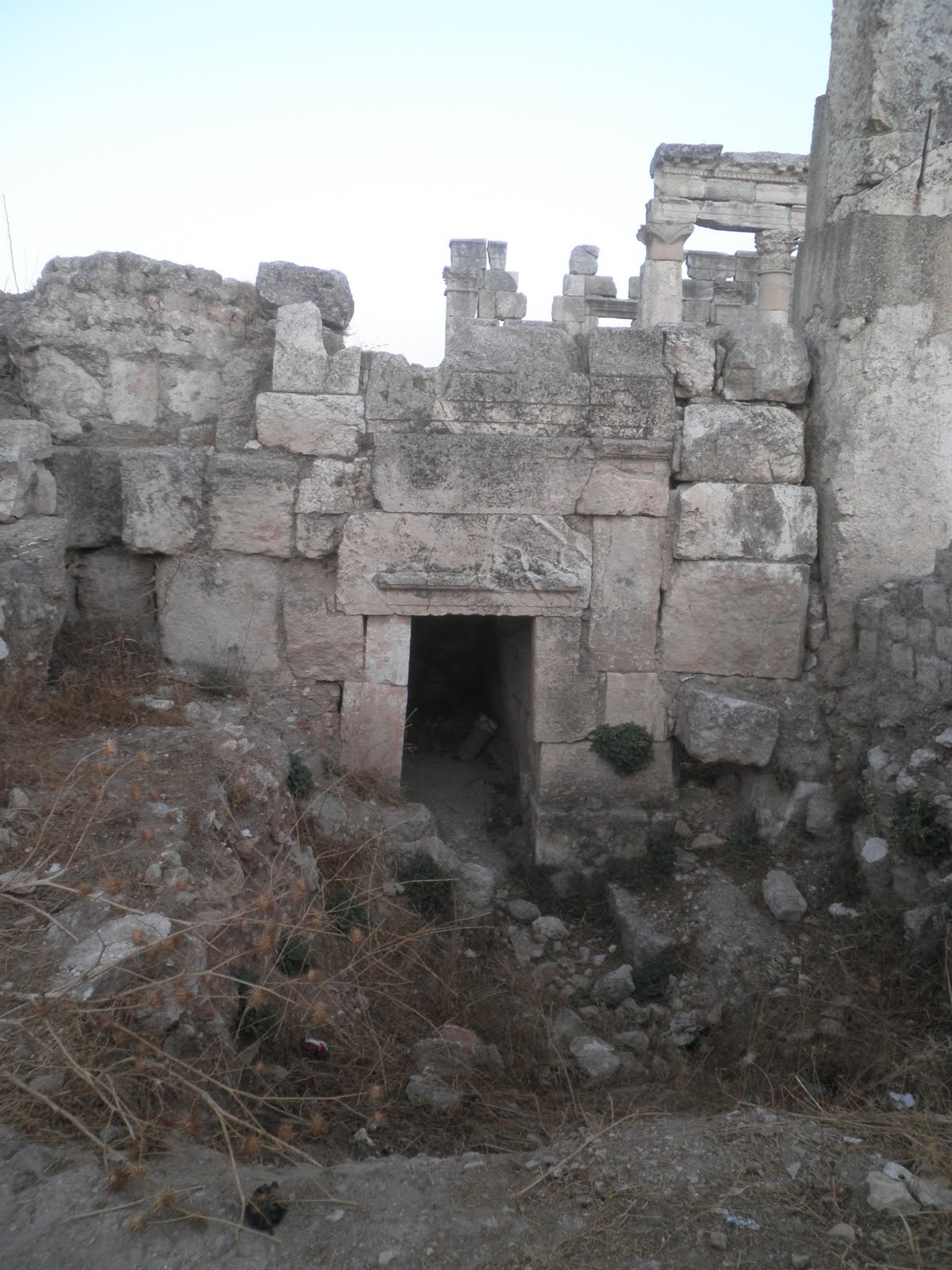
Apamea was a special place for all the family and especially Fawaz as he spent much of his childhood playing with his friends amidst the historical ruins. The corridor of classical fluted columns was a familiar backdrop for our Spring and Autumn excursions. Observing the occassional group of tourists meandering along the ancient stone passageway that formed the Cardo Maximus, which was originally 2km long and the main thoroughfare through the city, was an enjoyable past time. Secretly, I wished to hear them speak in English but the predominant languages spoken were French, German or Dutch. I identified with the beauty and history of the once bustling Apamea, more so, than the village of Skelbieh because in years 11 and 12 I studied the history of ancient art in Mesopatamia and the Middle East. Collecting art history books had been a passion of mine since I was in primary school and I would receive them for birthday and Christmas presents. I even spent the money I had saved to buy my year 12 school formal dress on a book of etchings and paintings by the German artist Albrecht Durer(1471-1528).
Apamea was my landscape for my dreaming and my soul. When times were tough and I was lonely for the companionship of old friends I found solace in the beauty and history of the lost city.

page 50


Tuesday, December 20, 2011

Masyaf

Masyaf (Moseearf) was situated a half hour drive south east of Skelbieh in the An Nusayriah mountains between Hama and the Mediteranean coast. It was a popular summer destination because of its cool summer climate and refreshing springs of water where open air cafes would offer its visitors a menu of scrumptious Arabic cuisine.
Masyaf's castle dates back to the Byzantine period and was used by the Ismailites in the 12th century to defend themselves against the ruling Sunni sects from Aleppo and Damascus. It was the fortress from which Ismaili leader Rashid ad-Din Sinan ruled. It sat high on a rocky prominence on the eastern side of the town overlooking the plains of the Oronte's river. The castle was in need of repair and during one of our visits to the fortress, Azzam found an accessible area to climb on one of its outside walls, but unfortunately, found himself in the middle of a clump of stinging nettle bushes.
In summertime, we would enjoy taking a leisurely trip to Masyaf to visit an old friend of Fawaz's and one of his daughters, Lena, was to become a very close confidante of mine.

page 49


The photos take one on a journey to Masyaf beginning at Skelbieh and travelling through the An Nusayriah mountains to the Masyaf castle.

Saturday, December 17, 2011

I received an occasional letter from my family in Australia but birthdays and Christmas were especially important times because there would be parcels delivered for the children from their aunties and grandmother in Australia. All mail went through a thorough screening by the Syrian authorities and if any article was deemed suspicious then it was confiscated. My mother and I wrote regularly to each other. I wrote my reflections on Syria onto pages and pages and sent them to her with a promise that she would keep them for safe keeping. I was so disappointed to find that upon my return to Australia they had been destroyed. Nonetheless, my memories of Syria were deeply embedded in my heart and mind and in my children's faces.
Five years had passed and we were all very excited by the news that my mother Jean was vacationing with us. She arrived at Damascus airport in the autumn of 1995 and was to stay with us for six weeks. Fawaz was glad to have his mother-in-law visit, although I wondered how long the mutual truce between them would last. Jean cut her stay short from six weeks to four weeks and I felt so sad as I thought we were having a wonderful time.
Lougene was thirteen months old when he first saw his grandmother and he wasn't to see her again for another three years. Even the thought of my mother leaving Syria brought me to tears, so I kept up a brave face until the day of her departure. We hired a small mini bus for our trip to Damascus airport and I sat next to her with Lougene on my lap and holding back my overwhelming compulsion to cry in her arms. She was not a physically affectionate mother but showed her love in other ways by doing things for the person she loved. There was a brief kiss and cuddle at the airport and she boarded her plane without much fuss.
It was a very long four hour drive home and I felt I had lost an important part of myself. When we reached Skelbieh in the late afternoon my thoughts turned to my daily routine of life, such as feeding and bathing the children and as usual, life moved forward and there only remained the melancholy memory of her visit.

page 48

Monday, December 12, 2011

Qal'at al-Hosn

One of the five fortifications rebuilt by the Crusaders between 1142 and 1271 stood proud and majestic perched on a hill surrounded by farmland and neighbouring villages. The site was first inhabited by the Kurds in the 11th century. Krac des Chevaliers also known as Qal'at al-Hosn is a most spectacular reminder of one of the most turbulent times in the history of Syria. During the 11th century the influence of the papacy and the religious confrontation between Christianity and Islam in Europe was a driving force towards spreading the influence of the Roman Church authority in the east. Mamluk Sultan Baibars captured the castle in 1271. He was one of the most renowned of the Mamluk Sultans of Egypt and Syria. He united Muslim Syria and Egypt into one commanding state and defended it from the Mongols and Crusaders. He managed to help the Mamluks to considerably expand their rule.

My good friend Saha, her husband Samir, Fawaz, Azzam, Yasmin and myself visited the Knights Templar stronghold one hot summer's day. It was a three hour drive to the castle situated east of the Mediterranean seaside town of Tartus in the Homs Gap. The steep and winding stairway leading into the main body of the castle was difficult to traverse but well worth the effort as the vista from the summit took my breath away. We walked along the jarred and rugged stones that formed the top of the citadel where the soldiers, armed with their weaponry, would have long ago defended their fortress.

The castle was only accessible from the south and lies on the spur of a hill, hence called a 'spur' castle. It also resembles a 'concentric' castle' which has the outer wall lower than the inner wall and thus can be defended from it. It resembles one castle built inside another.

page47


Sunday, December 11, 2011


Brahim's lunch offering


A cave dweller in Brahim's village


Fields surrounding Skelbieh


Watermelons for sale


Skelbieh


Fawaz had many good friends who were medical specialists and they looked after the health of our family during our stay in Syria. Some of them had trained as doctors in Russia. One of his childhood trustworthy friends was Doctor Fawaz, a neurologist, who had studied in St. Petersburg, where he met his wife Luda, a pharmacist. Fawaz would telephone him if the children or I were ill and Dr Fawaz would come to visit us, in our home, at any time of the day or night.
My dear friend and fellow artist was Doctor Olga and she was married to Doctor Rafeak. He too, studied in Russia and he met his blonde haired, statuesque wife at the same university in Moscow.
Olga and I became good friends and we shared many interests in common. However, at the beginning of our friendship we did have difficulty verbally communicating with each other because she spoke Russian and Arabic with a Russian accent, which was difficult for me to understand. She had learnt to speak Arabic at a college whilst studying in Russia. On the other hand, I had taught myself to speak my version of the Arabic language and was oftentimes embarrassed by my lack of grammatical knowledge. Fawaz was not concerned about my mispronunciations of his beautiful aurally aesthetic language and he did not have the patience to correct every word that I mispronounced, so I floundered along with my own interpretation. Olga and I managed a beautiful friendship and we connected on a deeper level that often didn't need verbalization. She was a gynecologist and worked from her clinic that was built onto her husband's family home. She had two young boys and lived with her in laws.
She was homesick for her country, mother and sister. Her patients mainly came from the small villages that surrounded Skelbieh. The women would give birth in her clinic. They were from the Muslim faith and their husband's were pleased that their wives were in the care of a compassionate and skilled female doctor.

page46

Friday, December 9, 2011

Aboo Feherd and Aboo Freharn were two old friends of Fawaz's father Aziz. The men lived next door to each other on the tel and Aboo Freharn was married to Aboo Feherd's sister and vise versa. Aboo Feherd was a short wiry man with an affable manner and his wife was tall, large in body with a deep, gruff voice. If she could, she would carry the woes of all her family and friends, as her heart was big enough to envelop them all. Aboo Freharn's physique resembled his sisters except for his low pitched, powerful, resounding voice. The two men were inseparable. They would visit Aziz and sit for hours reminiscing about the old days in Skelbieh and the hardships they endured.
For instance, they told me about the winter months that they spent on the tel in years gone by and the rats that were forced from the barren fields to search for food in the villagers' homes and how they used to visit at night and nibble on the inhabitant's toes. Aboo Freharn told me about how they would get snowed in and could not leave their homes in the winter months except by walking from one neighbour's roof to another. He would have to shake his sheepskin cloak to rid it of lice. Life was much easier for them since those supposedly 'good old days' but they missed the love and support each family bestowed upon each other because without it, they may not have survived those grueling winter months.

page 45

Thursday, December 8, 2011

After we returned home on a bitterly cold and niveous afternoon with our beautiful bundle of joy, we were welcomed by Fawaz's sister in law and her six young girls. I was appreciative to have a welcoming party but the noise of eight children all under the age of eleven was too much to bear, especially as we were all confined to one large room with a kerosene heater(soopeear) warming their little bodies from the cold of a chilly wintry day.
I needed to sleep and could not relax as there really was no such thing as 'personal space' in Fawaz's extended family. Eptisam had offered her services to look after Fawaz and the children and to cook for my family. I was indebted to her for her generosity which also came as a double edged sword.
It was customary for the mother or mother in law of the woman giving birth to be present at the delivery of the baby. Fawaz was in attendance when Lougene was delivered and his mother was so upset because she thought she wasn't welcome at the birth that she didn't visit me for three weeks. As usual, I was unaware of all the drama going on behind the scenes and just wanted everyone to go home. Eptisam and her mother in law (Fawaz's mother), were not on good terms, so helping me after the birth, was not only an act of generosity but also had the sweet effect of reigniting Bahija's flame of displeasure.
That night I became very ill with a high temperature and could not stand unaided. My fever reached the height of delirium and a doctor was called to my bedside. During the next couple of days I was in and out of consciousness and can only remember Lougene being placed on my breast to feed before I would fall into a deep sleep brought on by the medication I was given. Thankfully the infection my body was fighting gradually eased and I could again enjoy holding my precious baby and Yasmin and Azzam.
Fawaz's friends and family (minus Bahija) visited us over the coming weeks to congratulate us on the birth of our new son. In Syria, it was the custom to offer sweets to visitors after a baby was born. Our visitors were invited to partake in a variety of coloured sugar coated chickpeas and almonds, baklava, chocolates and a sip of strong, brewed Arabic coffee.

page 44

Brahim

Many of our visitors lived outside of Skelbieh and there was usually no advance knowledge that our friendly callers would be coming. Fawaz had one particular friend who lived in a small farming community between Skelbieh and Hama. His name was Brahim and we had visited him and his family on numerous occasions. There were caves in the hills that surrounded his village and Brahim still enjoyed the comfort that they afforded him when visiting his family who occupied one of them. He was a charming and hospitable host. Whenever we visited him there would be a feast of delicious food laid out on the sinees(trays) for our consumption. His wife and daughters would cook for hours and happily serve us. His demeanor was typical of a Syrian male. He was the head of his household and he was in charge, although gentle in spirit and kind in his attitude towards his family. His wife and children were delighted to cook for their visitors. He had been married for over twenty years and like himself, his wife was a compassionate soul and dedicated in her duty towards her family.
You can imagine my surprise when he came to visit us one day with a young very attractive woman sitting astride and holding onto him on his trusty and sturdy Lambretta. He had brought his second wife to Skelbieh to introduce her to us. I felt sadness for his first wife who I later found out was still living in the same household with his new partner.
Apparently, she was very upset that Brahim had chosen a second wife.
I made our visitors feel welcome whilst at the same time trying to imagine how I would feel if Fawaz had acted in the same manner and remarried whilst I was still married to him and living in Syria. There was no forewarning of Brahim's intended nuptuals. His marriage was legal.
The Skelbieh folk could not divorce in the strict Greek Orthodox Church, let alone remarry.
Fawaz, however, could marry many wives and there would be an ongoing joke that was carried out in front of me by his Christian friends concerning the possibility of Fawaz having more wives. They wanted to see my reaction but I showed them that even the possibility of such an occurrence in our marriage was out of the question.

page 43