Thursday, December 22, 2011

Apamea

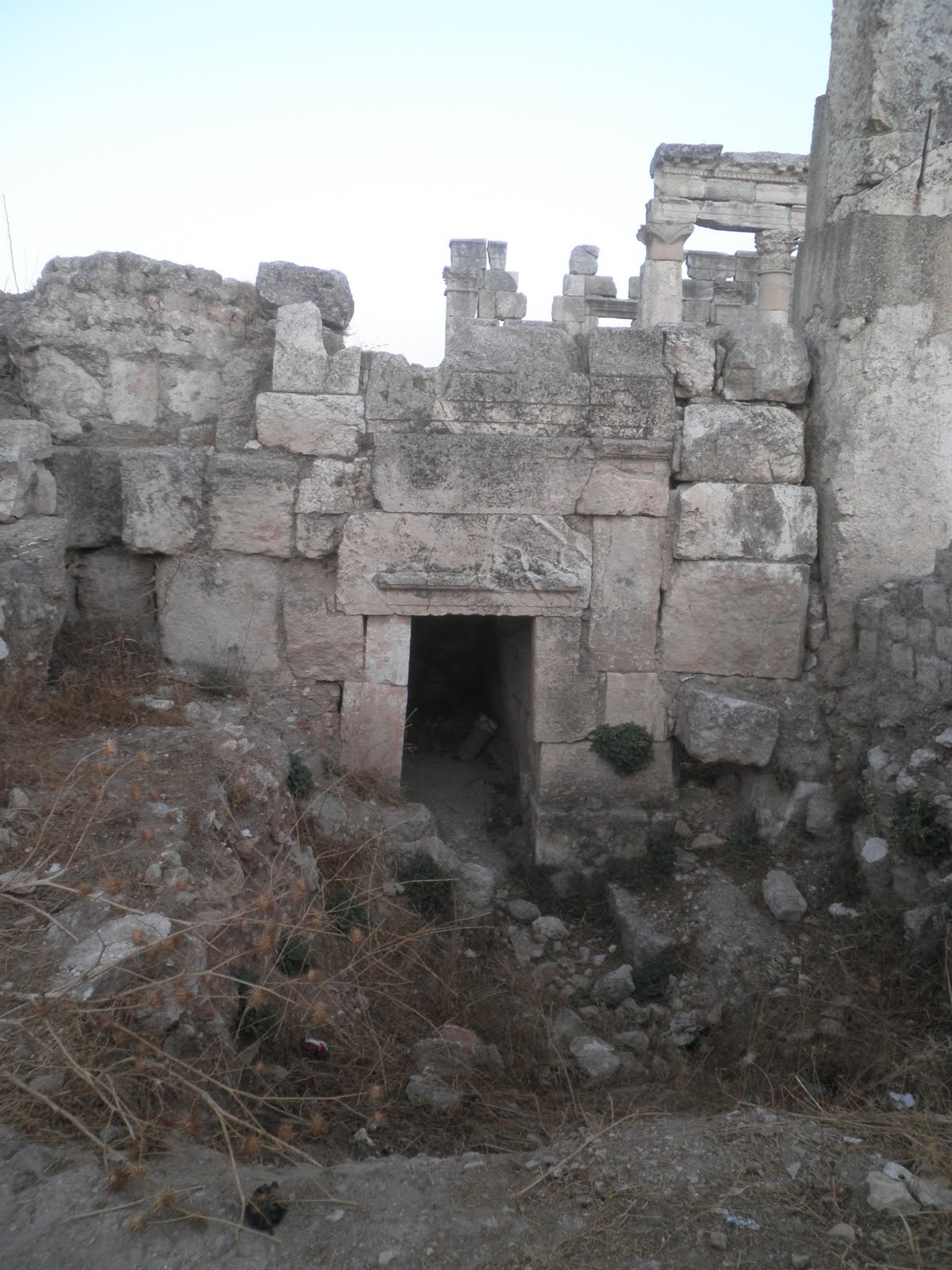
Apamea was a special place for all the family and especially Fawaz as he spent much of his childhood playing with his friends amidst the historical ruins. The corridor of classical fluted columns was a familiar backdrop for our Spring and Autumn excursions. Observing the occassional group of tourists meandering along the ancient stone passageway that formed the Cardo Maximus, which was originally 2km long and the main thoroughfare through the city, was an enjoyable past time. Secretly, I wished to hear them speak in English but the predominant languages spoken were French, German or Dutch. I identified with the beauty and history of the once bustling Apamea, more so, than the village of Skelbieh because in years 11 and 12 I studied the history of ancient art in Mesopatamia and the Middle East. Collecting art history books had been a passion of mine since I was in primary school and I would receive them for birthday and Christmas presents. I even spent the money I had saved to buy my year 12 school formal dress on a book of etchings and paintings by the German artist Albrecht Durer(1471-1528).
Apamea was my landscape for my dreaming and my soul. When times were tough and I was lonely for the companionship of old friends I found solace in the beauty and history of the lost city.

page 50


Tuesday, December 20, 2011

Masyaf

Masyaf (Moseearf) was situated a half hour drive south east of Skelbieh in the An Nusayriah mountains between Hama and the Mediteranean coast. It was a popular summer destination because of its cool summer climate and refreshing springs of water where open air cafes would offer its visitors a menu of scrumptious Arabic cuisine.
Masyaf's castle dates back to the Byzantine period and was used by the Ismailites in the 12th century to defend themselves against the ruling Sunni sects from Aleppo and Damascus. It was the fortress from which Ismaili leader Rashid ad-Din Sinan ruled. It sat high on a rocky prominence on the eastern side of the town overlooking the plains of the Oronte's river. The castle was in need of repair and during one of our visits to the fortress, Azzam found an accessible area to climb on one of its outside walls, but unfortunately, found himself in the middle of a clump of stinging nettle bushes.
In summertime, we would enjoy taking a leisurely trip to Masyaf to visit an old friend of Fawaz's and one of his daughters, Lena, was to become a very close confidante of mine.

page 49


The photos take one on a journey to Masyaf beginning at Skelbieh and travelling through the An Nusayriah mountains to the Masyaf castle.

Saturday, December 17, 2011

I received an occasional letter from my family in Australia but birthdays and Christmas were especially important times because there would be parcels delivered for the children from their aunties and grandmother in Australia. All mail went through a thorough screening by the Syrian authorities and if any article was deemed suspicious then it was confiscated. My mother and I wrote regularly to each other. I wrote my reflections on Syria onto pages and pages and sent them to her with a promise that she would keep them for safe keeping. I was so disappointed to find that upon my return to Australia they had been destroyed. Nonetheless, my memories of Syria were deeply embedded in my heart and mind and in my children's faces.
Five years had passed and we were all very excited by the news that my mother Jean was vacationing with us. She arrived at Damascus airport in the autumn of 1995 and was to stay with us for six weeks. Fawaz was glad to have his mother-in-law visit, although I wondered how long the mutual truce between them would last. Jean cut her stay short from six weeks to four weeks and I felt so sad as I thought we were having a wonderful time.
Lougene was thirteen months old when he first saw his grandmother and he wasn't to see her again for another three years. Even the thought of my mother leaving Syria brought me to tears, so I kept up a brave face until the day of her departure. We hired a small mini bus for our trip to Damascus airport and I sat next to her with Lougene on my lap and holding back my overwhelming compulsion to cry in her arms. She was not a physically affectionate mother but showed her love in other ways by doing things for the person she loved. There was a brief kiss and cuddle at the airport and she boarded her plane without much fuss.
It was a very long four hour drive home and I felt I had lost an important part of myself. When we reached Skelbieh in the late afternoon my thoughts turned to my daily routine of life, such as feeding and bathing the children and as usual, life moved forward and there only remained the melancholy memory of her visit.

page 48

Monday, December 12, 2011

Qal'at al-Hosn

One of the five fortifications rebuilt by the Crusaders between 1142 and 1271 stood proud and majestic perched on a hill surrounded by farmland and neighbouring villages. The site was first inhabited by the Kurds in the 11th century. Krac des Chevaliers also known as Qal'at al-Hosn is a most spectacular reminder of one of the most turbulent times in the history of Syria. During the 11th century the influence of the papacy and the religious confrontation between Christianity and Islam in Europe was a driving force towards spreading the influence of the Roman Church authority in the east. Mamluk Sultan Baibars captured the castle in 1271. He was one of the most renowned of the Mamluk Sultans of Egypt and Syria. He united Muslim Syria and Egypt into one commanding state and defended it from the Mongols and Crusaders. He managed to help the Mamluks to considerably expand their rule.

My good friend Saha, her husband Samir, Fawaz, Azzam, Yasmin and myself visited the Knights Templar stronghold one hot summer's day. It was a three hour drive to the castle situated east of the Mediterranean seaside town of Tartus in the Homs Gap. The steep and winding stairway leading into the main body of the castle was difficult to traverse but well worth the effort as the vista from the summit took my breath away. We walked along the jarred and rugged stones that formed the top of the citadel where the soldiers, armed with their weaponry, would have long ago defended their fortress.

The castle was only accessible from the south and lies on the spur of a hill, hence called a 'spur' castle. It also resembles a 'concentric' castle' which has the outer wall lower than the inner wall and thus can be defended from it. It resembles one castle built inside another.

page47


Sunday, December 11, 2011


Brahim's lunch offering


A cave dweller in Brahim's village


Fields surrounding Skelbieh


Watermelons for sale


Skelbieh


Fawaz had many good friends who were medical specialists and they looked after the health of our family during our stay in Syria. Some of them had trained as doctors in Russia. One of his childhood trustworthy friends was Doctor Fawaz, a neurologist, who had studied in St. Petersburg, where he met his wife Luda, a pharmacist. Fawaz would telephone him if the children or I were ill and Dr Fawaz would come to visit us, in our home, at any time of the day or night.
My dear friend and fellow artist was Doctor Olga and she was married to Doctor Rafeak. He too, studied in Russia and he met his blonde haired, statuesque wife at the same university in Moscow.
Olga and I became good friends and we shared many interests in common. However, at the beginning of our friendship we did have difficulty verbally communicating with each other because she spoke Russian and Arabic with a Russian accent, which was difficult for me to understand. She had learnt to speak Arabic at a college whilst studying in Russia. On the other hand, I had taught myself to speak my version of the Arabic language and was oftentimes embarrassed by my lack of grammatical knowledge. Fawaz was not concerned about my mispronunciations of his beautiful aurally aesthetic language and he did not have the patience to correct every word that I mispronounced, so I floundered along with my own interpretation. Olga and I managed a beautiful friendship and we connected on a deeper level that often didn't need verbalization. She was a gynecologist and worked from her clinic that was built onto her husband's family home. She had two young boys and lived with her in laws.
She was homesick for her country, mother and sister. Her patients mainly came from the small villages that surrounded Skelbieh. The women would give birth in her clinic. They were from the Muslim faith and their husband's were pleased that their wives were in the care of a compassionate and skilled female doctor.

page46

Friday, December 9, 2011

Aboo Feherd and Aboo Freharn were two old friends of Fawaz's father Aziz. The men lived next door to each other on the tel and Aboo Freharn was married to Aboo Feherd's sister and vise versa. Aboo Feherd was a short wiry man with an affable manner and his wife was tall, large in body with a deep, gruff voice. If she could, she would carry the woes of all her family and friends, as her heart was big enough to envelop them all. Aboo Freharn's physique resembled his sisters except for his low pitched, powerful, resounding voice. The two men were inseparable. They would visit Aziz and sit for hours reminiscing about the old days in Skelbieh and the hardships they endured.
For instance, they told me about the winter months that they spent on the tel in years gone by and the rats that were forced from the barren fields to search for food in the villagers' homes and how they used to visit at night and nibble on the inhabitant's toes. Aboo Freharn told me about how they would get snowed in and could not leave their homes in the winter months except by walking from one neighbour's roof to another. He would have to shake his sheepskin cloak to rid it of lice. Life was much easier for them since those supposedly 'good old days' but they missed the love and support each family bestowed upon each other because without it, they may not have survived those grueling winter months.

page 45

Thursday, December 8, 2011

After we returned home on a bitterly cold and niveous afternoon with our beautiful bundle of joy, we were welcomed by Fawaz's sister in law and her six young girls. I was appreciative to have a welcoming party but the noise of eight children all under the age of eleven was too much to bear, especially as we were all confined to one large room with a kerosene heater(soopeear) warming their little bodies from the cold of a chilly wintry day.
I needed to sleep and could not relax as there really was no such thing as 'personal space' in Fawaz's extended family. Eptisam had offered her services to look after Fawaz and the children and to cook for my family. I was indebted to her for her generosity which also came as a double edged sword.
It was customary for the mother or mother in law of the woman giving birth to be present at the delivery of the baby. Fawaz was in attendance when Lougene was delivered and his mother was so upset because she thought she wasn't welcome at the birth that she didn't visit me for three weeks. As usual, I was unaware of all the drama going on behind the scenes and just wanted everyone to go home. Eptisam and her mother in law (Fawaz's mother), were not on good terms, so helping me after the birth, was not only an act of generosity but also had the sweet effect of reigniting Bahija's flame of displeasure.
That night I became very ill with a high temperature and could not stand unaided. My fever reached the height of delirium and a doctor was called to my bedside. During the next couple of days I was in and out of consciousness and can only remember Lougene being placed on my breast to feed before I would fall into a deep sleep brought on by the medication I was given. Thankfully the infection my body was fighting gradually eased and I could again enjoy holding my precious baby and Yasmin and Azzam.
Fawaz's friends and family (minus Bahija) visited us over the coming weeks to congratulate us on the birth of our new son. In Syria, it was the custom to offer sweets to visitors after a baby was born. Our visitors were invited to partake in a variety of coloured sugar coated chickpeas and almonds, baklava, chocolates and a sip of strong, brewed Arabic coffee.

page 44

Brahim

Many of our visitors lived outside of Skelbieh and there was usually no advance knowledge that our friendly callers would be coming. Fawaz had one particular friend who lived in a small farming community between Skelbieh and Hama. His name was Brahim and we had visited him and his family on numerous occasions. There were caves in the hills that surrounded his village and Brahim still enjoyed the comfort that they afforded him when visiting his family who occupied one of them. He was a charming and hospitable host. Whenever we visited him there would be a feast of delicious food laid out on the sinees(trays) for our consumption. His wife and daughters would cook for hours and happily serve us. His demeanor was typical of a Syrian male. He was the head of his household and he was in charge, although gentle in spirit and kind in his attitude towards his family. His wife and children were delighted to cook for their visitors. He had been married for over twenty years and like himself, his wife was a compassionate soul and dedicated in her duty towards her family.
You can imagine my surprise when he came to visit us one day with a young very attractive woman sitting astride and holding onto him on his trusty and sturdy Lambretta. He had brought his second wife to Skelbieh to introduce her to us. I felt sadness for his first wife who I later found out was still living in the same household with his new partner.
Apparently, she was very upset that Brahim had chosen a second wife.
I made our visitors feel welcome whilst at the same time trying to imagine how I would feel if Fawaz had acted in the same manner and remarried whilst I was still married to him and living in Syria. There was no forewarning of Brahim's intended nuptuals. His marriage was legal.
The Skelbieh folk could not divorce in the strict Greek Orthodox Church, let alone remarry.
Fawaz, however, could marry many wives and there would be an ongoing joke that was carried out in front of me by his Christian friends concerning the possibility of Fawaz having more wives. They wanted to see my reaction but I showed them that even the possibility of such an occurrence in our marriage was out of the question.

page 43

Wednesday, September 21, 2011

Bundle of Love

The night before I gave birth to my third child I was filled with fear. Earlier in the day I had been told by the doctor at the local hospital to return home and prepare myself for an induced birth on the following day. There had been complications and a real threat of having a still birth. I wanted to be surrounded by nurses and doctors and machines to monitor my babies heart but instead, I lay awake all night having dreadful visions of the grim reaper. On this one occasion I wished I hadn't been gifted with such a vivid imagination.
The next morning I kissed my beautiful Yasmin and Azzam goodbye. They were extremely upset that I was leaving them, even though as it turned out, I was only in the hospital for approximately four memorable hours.
It was not the custom for the father to watch the birth of their child in Syria but Fawaz was not going to miss out on the birth of our third baby, so he and the ill tempered old nurse were in a Mexican stand off and of course, Fawaz won.
The Russian wife of the local paediatrician happened to be passing my room and popped her head in and commented that my bed and blanket were in a worse condition then the ones found in a Russian prison. Her comments only added to my anxiety and when I had to use the toilet I found it under the stairs and the steel mobile drip stand could not fit in the tiny space so I had to enter unaided with the stand on an angle and use the hole in the floor.
The local Skelbieh folk were fed up with the poor standard of their only private hospital and that prompted a group of local medical specialists to plan and build a new modern hospital.
It was still in the process of being built when I gave birth to my third child.
Fortunately, there were no complications during the birth and we were blessed with a healthy three and a half kilo baby boy. That was a surprise to me because a previous ultrasound apparently showed that I was having a girl. Nevertheless, I loved my son from the first moment I lay eyes on him. Yasmin and Azzam were waiting excitedly in the ward to join their baby brother.
After about an hour of observation, the baby and I were allowed to go home. We didn't own a car and there were no taxis in the town so our only means of transport on that day was with one of our friends who owned a pickup. Fawaz and the two older children drove home first and the driver came back with Fawaz to take the baby and I. It was wintertime and it was snowing and all I cared about was the bundle of love that I held in my arms.

page 42

As I walked the winding and narrow streets between the old mud houses on the tel I was taken back to another time and century when the only means of transport were donkeys or horse and cart. There was only enough room to fit two people walking side by side and the surface of the ground was rocky and dusty. Sometimes I felt as though I was an intruder walking around the narrow passageways of the closely knit hill dwellers. Although, I did have two older female friends who seemed to be the matriarchs of the hill society. They were huge in stature, loud with laughter, strong in defiance and with hearts of gold. Whenever they saw me taking one of my strolls or shortcuts through the tel they would call out to me to come and join them for coffee or tea and upon my arrival they would squeeze my cheeks with their huge earth worn hands, then proceed to suction the moisture from them with kisses to the left, right and left again. By the time the two of them had finished their greeting on me I was in need of a strong Arabic coffee. They would talk and laugh and cuddle me and most of the time I didn't have a clue as to what they were talking about but I loved them nevertheless.
Once, on one of my afternoon walks I came across a pool of blood that was trickling down the narrow passageway. As I approached the source of the blood I could hear music and the sound of merriment coming from one of the courtyards. A goat had been sacrificed and its blood spilt at the entrance to the bride's family residence in honour of her intended nuptials.
When we moved into our new home Fawaz's mother wanted to kill a chicken and spread its blood over the front entrance for good luck but thank goodness Fawaz told her it wasn't necessary.
The Skelbieh women were very superstitious. They believed in the evil eye. If a child fell sick or a lady had a miscarriage or someone was losing too much hair then it was often blamed on the evil eye. They would say that a woman without a child was jealous and if that emotion happened to be directed at a particular person then the power of their thought combined with their feeling would cause something bad to happen to the individual. To protect a baby from the curse, the mother would pin a tiny blue glass replica of an eye onto the infant's clothing to reflect any negative thoughts that may have been directed towards it.
Once the family had decided that a curse had been placed on the child then they would take means to remedy it. A ball of lead was then placed in a large spoon and heated over an open flame. Once it had melted a pot of cold water was safely held over the head of the child, The lead would then be dropped into the water and a popping sound could be heard. That meant the curse had been lifted and the child was safe. The lead would form into a new shape in the cold water and that would give the family a clue as to the perpetrator of the curse.

page 41

Monday, September 19, 2011

Fields of Gold


Listening to Eva Cassidy's song Fields of Gold brings back memories of the days spent with my children in the meadows surrounding Skelbieh. I loved watching the field ants as they followed each other in unison carrying their humble offerings on their back. The harsh sun and parched summer months had left their toll on the sun baked soil. The golden stalks of wheat were ready for harvest after the sleepy winter months had passed into a romantic and wistful spring then into summer when the townsfolk would be in a hive of activity busily reaping the rewards from their ripened crops.
The watermelon truck would park in the street under the shade of our veranda and Fawaz would haggle with the driver for a cheaper price per kilo. The workers would be having a siesta on top of the melons and once a price was agreed upon the children and Fawaz would collect the fruit from the truck and carry the twenty or so watermelons up two flights of stairs.
We bought boxes of apricots, peaches, mulberries, cherries and stone fruits that were grown in the nearby mountains at the local fruit and vegetable market. In summer we ate boiled, white, salted cheese made from sheep's milk with watermelon slices for breakfast.
The local theme park would open its gates in the evening and the children would enjoy a ferris ride or a drive in a dodgem car. Young men would be arm in arm strolling down the main thoroughfares perusing the scene for a glimpse of their sweethearts.
At open air summer cafes one could buy ice cream and soda with a home made jelly like sweet called kesharf. If one wasn't in the mood for an evening stroll, then they were probably sitting outside and enjoying the company of friends and family. The cooler Mediterranean nights brought much relief from the searing heat of the day.

40

Saturday, September 17, 2011

Anaesthetic

I was in such awe of the women in the town, because unlike myself, most of the women and men used to visit the dentist to have their teeth filled or pulled without the use of any anaesthetic. Fawaz would ask the dentist, much to his amusement, to give me a needle for any dental work. To suffer any unnecessary pain was not something I was used to. On one occasion Fawaz's brother was swimming in the Mediterranean sea whilst he was taking a break during his compulsory army service and he cut his foot on an extremely sharp and jagged rock. Without much ado he simply sewed up the the gash using a needle and thread.
During the European Economic Community embargo placed upon Syria in the early 1990s there was a shortage of essential medicines which included anaesthetics used by dentists. I can remember the agony I was forced to endure for two weeks due to an infected tooth and the dentist saying to me that he wasn't sure whether or not it needed to be removed. The pain was so severe that I was taking panadol every two hours. There were many occasions where I'd kneel on the floor with my head in my lap and pray for help. Finally I was referred to a dentist in Hama who immediately performed an operation on my lower left jaw for an infected, impacted wisdom tooth. However he did not have enough anaesthetic to last the whole operation so I was crying with the pain I was feeling as soon as he finished the last stitch and the agony I experienced on the journey home was unbearable. My face was purple and swollen for at least a week.
A few months later I suffered a miscarriage. I wasn't aware that I was pregnant when I was taking the painkillers which had caused distress to the foetus. Again, I experienced a nightmare trip to the recently opened private hospital where the keys to the operating theatre cupboard had been accidentally taken home by the night nurse. We had to wait for them to be returned before my operation could take place. Again, I was under anaesthetic but this time I was aware of the surgeon scraping my womb and unable to move or tell anybody that I was still awake. Not long after the remaining anaesthetic wore off I was on my way home on a cold winters night and grateful I had survived the most horrific haemorrhage and unforgettable nightmare.
That is not to say that everyone had my experiences. I definitely think that it was an unfortunate set of circumstances.
Azzam came home one morning crying with pain because he had cut his ankle and foot on a broken glass bottle that was hidden in the grass.
The cut was so deep that I could see his bone. Fawaz had already left the house and I was alone. I carried Azzam downstairs and stood in the street frantically calling out "help" in English. Luckily, a concerned young man could understand the distress I was in, so he approached Azzam and I and took Azzam from my arms and hailed down the nearest motorbike rider, then hopped on the bike and carried him to the local hospital. Skelbieh folk didn't need telephones in times of emergency. The word was sent via passing traffic to find Fawaz as his son was in hospital and so be it, he was found. In less than half an hour he was scrubbed up and watching the surgeon perform a sensitive operation sewing Azzam's nerves and flesh together. He performed the job of a neurosurgeon because in a small town far from the city of Hama and with little time to repair the damage done to Azzams ankle and foot the surgeon did what he had to do.

39

Thursday, August 25, 2011

Leaving with us this musical treasure, Israel Kamakawiwo'ole, the giant man with the little ukulele and an angelic voice, passed away on June 26, 1997. This Spadecaller video presentation honors the man and his music. Aloha!

In Loving Memory

Thoughts

The song "What a wonderful World" by Loui Armstrong lifts my spirits whenever I listen to it. I was sent an e-mail requesting that I say the words IT IS A WONDERFUL WORLD when I read or heard anything negative. That was not an easy thing for me to do as it was a difficult week so I wrote Wonderful World on my hand and said the words whenever I needed them. I wasn't really in tune with the words so I decided to, as they say "FAKE IT TIL YOU MAKE IT" and was reminded of the beautiful song by Loui Armstrong. (I named one of my children after him.)
The e-mail read

It is a Wonderful World
Hold the ideal vision for our world’s economic stability and harmony among all beings.

Your thoughts matter.

I began my story about my time spent in Syria with a heart full of love for its people, culture, history, art and spirituality. They embraced my children and I and I have been so saddened by the turmoil and grief of the Syrian people. I am continuing my story in honour of the wonderful people I met and lived with and pray for peace.

A SONG FOR SYRIA

Wednesday, August 24, 2011

AMAZING GRACE sung by Paul Robeson


Amazing grace! (how sweet the sound)
That sav’d a wretch like me!
I once was lost, but now am found,
Was blind, but now I see.

’Twas grace that taught my heart to fear,
And grace my fears reliev’d;
How precious did that grace appear,
The hour I first believ’d!

Thro’ many dangers, toils and snares,
I have already come;
’Tis grace has brought me safe thus far,
And grace will lead me home.

The Lord has promis’d good to me,
His word my hope secures;
He will my shield and portion be,
As long as life endures.

Yes, when this flesh and heart shall fail,
And mortal life shall cease;
I shall possess, within the veil,
A life of joy and peace.

The earth shall soon dissolve like snow,
The sun forbear to shine;
But God, who call’d me here below,
Will be forever mine.

written by John Newton

Fairuz sings for the Palestinian People

Wednesday, May 25, 2011

The children were playing in the fields next to their grandparent's house and thoroughly enjoying themselves when I spotted a Bedouin tending to his flock of brown faced, fat tailed Awasi sheep. He looked so regal dressed in his silk embroidered black linen galapea, blue jacket and shemagh (traditional Arabic headgear). Azzam ran towards the sheep and like a bull at a gate he found himself in the middle of the flock and nudging them along a narrow pathway towards his play area. The shepherd was most amused at his antics and I tried to intervene and grab Azzam but he managed to wiggle his way out of my arms and run for shelter behind the sheep. Fortunately, Bahija arrived and managed to coax Azzam out of the flock and gain his trust by talking to the man about allowing Azzam to sit on the back of one of his sheep. He politely obliged and Azzam sat proud on the animals back although betwixt as to what he had got himself into. He was then content to bid farewell to his new friend and we made our way home with a promise to visit Azzam's animal friends and their keeper the following day.
The children's uncle Suhbarn was an artist and a sculpture. He worked in Lebanon and made sculptures of eagles, lions, mother Mary and other religious deities. He lived the life of a tortured artist and poet who spent his idle days in cafes, chain smoking and drinking Arabic coffee with friends whilst discussing the whys and wherefores of life's peculiarities. He was fascinated by my outlook on life and the enjoyment I took from the simple pleasures that most people he knew took for granted. He accompanied the children and myself on many of our excursions to the fields and even taught me how to shoot a gun and rifle. When he had a bit too much to drink he was banished from the house and he slept in his tent that he erected in the meadow adjacent to Fawaz's family home. He was such a character and known as one of the strongest men in the town and nobody picked a fight with him unless they had a death wish. He would click his fingers and his sisters would come running and answer to his every whim. I was so annoyed with him not long after I had arrived in Syria when I caught him fighting with Hozarm his younger sister, who was about seventeen at the time. He was yelling at her in the kitchen and trying to hit her and she was cowering in a corner, so I stood in-between them and chided him for his cowardice whilst holding him back from his sister. He had no idea of what I was saying but he got the gist and never displayed such rude behaviour in front of my presence again. I disliked the way the girls were at the beck and call of their brothers to make them coffee or tea or iron their clothes or dry their hair. I knew that Yasmin would not be following in her auntie's footsteps.
I only saw one woman drive a car in Skelbieh as it was not common for them to ride a motorcycle or drive. The women were in charge of the home and housework and men would often purchase the food. The baker opened at four in the morning and most families sent someone out to buy bread each morning at about five o'clock.
Bahija could not read or write in Arabic. When she was younger she would help around the home and was married at sixteen years of age. She gave birth to sixteen children but only twelve survived. Both of her younger daughters completed year twelve at high school and she was very proud of their achievements. Fawaz, her eldest child left Skelbieh when he was nineteen to work overseas in Greece. Her next son Mann worked between Lebanon and Syria and Manhal moved to work and live in Russia. Mohunned, Dored and Harris all worked in Lebanon at one time or another and Dored also worked in Saudi Arabia. Hazim moved to Baalbek in Lebanon to work as a welder and married one of their local girls.
Bahija would worry about all her children, especially if they were away from their home. I remember one morning she was distraught because of a dream that she had the previous evening. She dreamt that something untoward had happened to her youngest son Harris. At that time he was working in Beirut and she sent two of her sons to Lebanon to find Harris and check that he was ok. There was no other way to contact him except by sending someone over there.
Of course he was perfectly healthy and enjoying his stay and she was content to know that her dream was not a premonition of an ill fated adventure.

page 38

Sunday, May 15, 2011

Telsikeen


Telsikeen which translates to hill(tel) and sikeen(knife) was a small village in the Gharb. Fawaz had quite a few relatives living there and they belonged to Bahija's clan. We were invited to Telsikeen to attend a wake after one of Fawaz's uncles had died. On our arrival we were greeted by the children of the household and led across a freshly hosed, uneven, cemented courtyard. We placed our shoes in a neat row and were directed into one of their two rooms and joined the men and women who were sitting Arabic style(on the floor with legs crossed). I was given a shawl to cover my legs and feet as it was apparently easier for me to relax with modesty. The atmosphere was sombre and hardly a word was spoken. Guests had brought goats and sheep as an offering to help the family of the deceased to feed their constant visitors, many of whom had travelled long distances to pay their respects.
I sat next to Fawaz and amongst an older generation of men dressed in their traditional Arabic attire which included their galapea, leather belt and shemly(headscarf).
The women served the food in huge round trays which were full of rice or bourgul (cooked cracked wheat) or freekee(wheat husks thrown into fire and burning charcoal for a small period of time and then de-husked). Bowls of salad and yoghurt and hummus(chickpeas) were placed in the middle of the room on table cloths. Lamb, chicken and goat were the main meats on the menu. A huge tray of rice was placed in front of me and sitting on the top was the skull of a goat that had been cooked with its tongue hanging out. I was offered the dish first as a sign of respect. Everyone was looking at me with eagerness whilst waiting for me to fill my plate with what was regarded as the most delicious part of the goat. I couldn't even look at the goats head let alone eat it and I felt myself slowly fading away but was suddenly jolted back to reality by the sound of laughter coming from the other guests. They were so amused by my reaction that even on such a sad occasion they could not help themselves but laugh at the over sensitive westerner that couldn't look at their cooked goat in the eye(I hope there wasn't one).
That laughter broke the ice and after their bellies were full everyone was more relaxed and were interested in talking to me about my opinion of their country and how I met Fawaz and how long I was going to stay in Syria.
A few years earlier one of the residents in Telsikeen was digging a well in his backyard and to his amazement discovered what was said to be ancient ruins under the village. The government erected signs prohibiting anybody from digging without permission. There were major repercussions if anyone was caught trying to unearth anything that belonged to the ruins that had lay hidden beneath the small farming community for many centuries.
Telsikeen was typical of the many villages that I had visited. The roads were often unpaved, thus were dusty in summer and muddy in winter and the villagers seemed to live outdoors most of the day, unlike Australians who tended to spend a large proportion of their day indoors. The men would sometimes be sitting with friends on the side of the road drinking coffee and sharing an argile(Arabic smoking pipe) or tinkering with their motorbikes.
At the top of an argile a bowl would be filled with tobacco then covered with perforated aluminium foil above which lit coals were placed. The jar or vase at the bottom of the argile was filled with water and the stem sat on top and the down stem below the level of the water. Smoke passed through that section of the body and out the bottom of the stem where it bubbled through the water. That cooled and humidified the smoke. It was then inhaled through the hose which allowed the smoke to be drawn for a distance thus cooling it down. Women and men both smoked from argiles and various flavours of tobacco were used including a home made molasses soaked tobacco.
I wasn't relaxed to be in Bahija's family room when Fawaz's brothers would smoke their cigarettes as both old and young shared the room that was also their bedroom at night. Fawaz asked our visitors not to smoke in our home because he was aware of the effects of passive smoking.
Aziz and Bahija's house was situated at the bottom of a hill and the roads that led to their home were not tarred. In the wet winter months, one would slip and slide their way down the tel and if for any reason one's momentum sped up, caused by the steepness of the hill, or the sludge beneath them gave way, then the unlucky person would end up face down and covered in mud.

page 37

Wednesday, May 11, 2011

Hama

The town of Skelbieh was part of the governorate of Hama. It was a sixty minute drive south west of its mother city. Whenever a baby was born in Skelbieh the parents had to register their baby in Hama at the office of Births, Deaths and Marriages. In the past, it was difficult to make the fifty or so kilometre trip to the city, so children from the same family were sometimes registered in bulk lots, on the day of their brother or sister's birth day.That was also the case in Fawaz's family. Aziz used to say that Fawaz was born on the twenty third of November and Bahija would argue that he was born on the thirteenth but I leant on the side of Aziz, because one of his other sons, Manhal, also had the thirteenth of November as his birth date. At least his year of birth was correct.
Hama is Syrias fourth largest city on the banks of the Orontes river and its citadel and its ancient waterwheels(norias) are its two most famous features. It has 17 norias dating back to the Byzantine times. They can go up to 20 metres in diameter. Hama has long been a crossroads between the Mediterranean and the East and has a history that dates back to 2,000 BC.
In the north, near the centre of the city of Hama you can find Citadel Hill. A park is situated at the summit and it is a popular area for locals and tourists alike, especially on warm summer evenings. Citadel Hill dates back to the 11th century BC, when Hama was the centre of the Aramean kingdom of Hamath and evidence unearthed dates back to the Neolithic period. Whenever we visited Hama the children loved to play on the slides, swings and monkey bars and picnic on the summit. It was a steep and winding path to traverse but when we reached the top the view of Hama was magnificent, as it was a most stunning and majestic city
The Christian population had their own quarters which was close to Citadel Hill. The children and I would enjoy eating the delicious sweets that the smaller cake shops offered. Yasmin's favourite was halawat al-jibne which was a sweet cheese pastry and a speciality of the city. We used to visit Hama on particular occassions such as Easter to buy chocolate Easter eggs, which were extremely difficult to find even in Hama. I made sure the children never missed out on any of the special treats and celebrations that I grew up with. I used to make their party hats by drawing characters from their golden books and colouring them in.
There was only one occasion that I felt prejudice against me in Syria and that was at a market in Hama when an old lady dressed in black was shouting at me because my long blonde hair was not hidden with a scarf. She was absolutely crazy with anger and Fawaz was nowhere to be seen as he was ahead of me at the souk. Eventually he heard the raucous she was causing and came to my aid. I couldn't understand what she was saying but I know he told her off and she carried on muttering to herself until she was out of view. Fawaz explained to me that she wasn't normal and not to take offence.
I used to dabble in numerology and had brought books from Australia on the subject to study. Sometimes when I would ask an older member of the community his or her birth date they were not one hundred percent sure of the exact day but could remember which season of the year they were born. For example, one man told me he was born just after the summer wheat harvest and another just before the winter rains. I enjoyed practising from David Phillip's book with Fawaz as my interpreter.

page 36

Wednesday, May 4, 2011

Aziz

The children and I spent six weeks in Australia and during that time I caught up with my family.
We stayed with my mother in her home and I enrolled Yasmin in kindergarten at the local infants school. There were times when I didn't want to return to Syria and I was torn between my love for Australia and the life I once knew and the commitment I had made to my husband and Syria, where the children were surrounded by cousins, aunties, uncles, grandparents and the memories of ancestors that dated back many hundreds of years.
Fawaz had reconciled with his father not long after he had bought our property. He was unhappy to be estranged from him for so long, as his father was unwell and dependent on his wife for his every need. Fawaz decided to purchase a wheelchair for his father Aziz, whose only means of mobility between his room and the footpath where he loved to spend his days socialising, was an armchair that one of his eight sons had managed to attach wheels to.
He made an eight hour return trip to Damascus and bought a reasonably priced modern wheelchair for his father but after all the effort he had put into pleasing him with his bright and shiny purchase, Aziz still preferred his well worn, home made, four wheeled, trusty old armchair.
Bahija was devoted to Aziz and she tended to his every need. It was so sweet to see her when she would cook a chicken for the family and save its livers for Aziz. I would watch her lovingly feed him as he consumed with delight one of his favourite foods. Even though his fingers were atrophied he could still manage to hold a spoon and shakily feed himself.
I loved Aziz and he was fond of me. He would be upset if he knew I was ill or sad. Aziz adored his children and grandchildren and I was so proud to be included in his family. Bahija was a tough woman, she had to be, as she had lived a difficult life and struggled for most of it, working hard to feed her children. Aziz rented a shop in the market and stocked it with second hand clothes and shoes. When we first arrived in Syria he would be transported by motorbike or tartoorah (a three wheeled vehicle) to his shop where he would sit and sell his wares. However, his kind and caring nature would see him giving away more clothes then he could sell and he'd return home each afternoon with barely any money in his pocket. On many occasions Bahija would ask him to stop giving away the merchandise, as his own family was in need of money to live on.
He loved honey and in winter time it was very difficult to find someone who sold it. Honey was only available from street vendors or farms. Once, Fawaz bought him eight kilos of honey and it was the first time in four years that my children had tasted it.
I took so much for granted in Australia. Foods were readily available in supermarkets, but not so in Skelbieh. I craved for a slice of toast with butter and vegemite. That was my favourite breakfast. Sometimes we could buy fresh bread rolls from a hawker but I remember only once buying a loaf of unsliced bread and a knob of cheddar cheese in Alleppo. Our Mediterranean diet was healthy and I looked forward to the occasional parcel from Australia containing peanut butter and vegemite.

page 35