Sunday, May 27, 2012

Personal Mandala


A personal mandala is a circular drawing, painting, collage or any creative motif that expresses the important parts of your life. Mandalas can represent your thoughts and feelings on a day to day basis like a journal or diary and can be
used to create a visual representation(symbols) of your world and its meaning. My mandala represented the beauty I saw in the world at the time I drew it and the things that were important to me. 2012

Friday, May 18, 2012

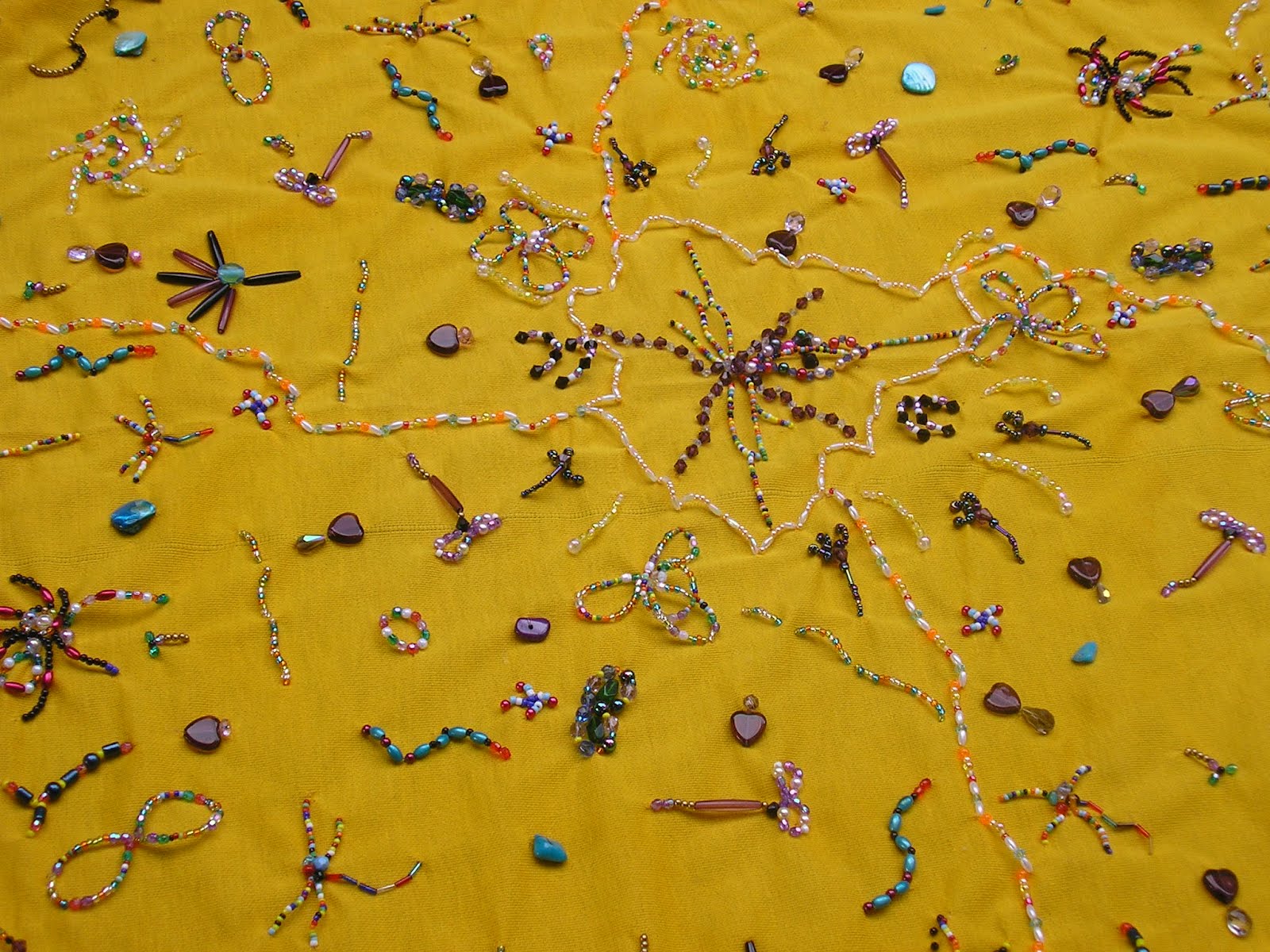
Temenos


The name Temenos is taken from a Greek word meaning the sacred space surrounding a temple or an altar. Carl Jung used this same word to refer to the inner space deep within us where soul-making takes place. In my Art Therapy course I beaded my Temenos which was placed on the floor in the middle of a group sitting in a circle. I had created a sacred space in which we were safe and held in trust for healing and learning. 2012


Saturday, May 12, 2012

Asmahan al-Atrache


Asmahan, whose birth name was Amil was the sister of Farid al-Atrache. In 1923 she fled Syria with her mother and two brothers after their home was bombed by the French army.
She performed in the 1930's and was famous for her voice and it rivalled the voice of the talented Egyptian singer Oum Kalthoum. The life of Asmahan is a tale of one of the most colourful, controversial, and inspiring women in the Arab world during the 20th century. She was a Druze princess who rebelled against society and marriage. She came from a distinguished clan from Suweyda in the mountains of Syria.
Her life, especially her private life was traumatic and after marrying her cousin Prince Hassan al-Atrache in 1933 she moved back from Egypt to Syria. The marriage didn't last and after giving birth to a daughter, Camellia, she returned to Egypt and was divorced in 1939. She had three marriages in her short lifetime. She was an admired performer, a role frowned upon for women of that time. She frequently visited the homes, as a guest, of many of Egypt's rich and famous, and was also rumoured to be an agent for the Allied forces during World War II. Her death in 1944 at the age of 32 was said to be in mysterious circumstances and gave rise to many conspiracy theories.

Friday, May 11, 2012

Farid al-Atrache


Farid al-Atrache was born in Syria and escaped the French occupation of Syria with his mother and siblings. They emigrated to Egypt where he became a composer, singer, virtuoso oud player and an actor. He was known as 'King of the Oud"(a musical instrument of the Middle East and northern Africa belonging to the lute family.)
He was also well known for writing his sad love songs in his musical films and most of the instrumentals and songs sung by other singers. He was deeply in love with an Egyptian belly dancer called Samia Gamal who he gave a small role to in one of his movies when she approached him at the age of eighteen with a bunch of flowers. She was a belly dancer who came from the town of Wana in Egypt.Farid was impressed with her beauty and she idolised him. She later became famous and made movies with Farid and on her own. Her mesmerising performances brought recognition for Oriental dancing worldwide. Their romance was to last for five years and he supposedly said he couldn't marry her because he was a Druze Prince and could only marry a Druze Princess. He did have a few loves throughout his lifetime but never married. In his movies he always took the romantic lead role of a heavy hearted singer.

SAMIA GAMAL

A Tear And A Smile by Khalil Gibran


I would not exchange the sorrows of my heart
For the joys of the multitude.
And I would not have the tears that sadness makes
To flow from my every part turn into laughter.

I would that my life remain a tear and a smile.

A tear to purify my heart and give me understanding
Of life's secrets and hidden things.
A smile to draw me nigh to the sons of my kind and
To be a symbol of my glorification of the gods.

A tear to unite me with those of broken heart;
A smile to be a sign of my joy in existence.

I would rather that I died in yearning and longing than that I live Weary and despairing.

I want the hunger for love and beauty to be in the
Depths of my spirit,for I have seen those who are
Satisfied the most wretched of people.
I have heard the sigh of those in yearning and Longing, and it is sweeter than the sweetest melody.

With evening's coming the flower folds her petals
And sleeps, embracing her longing.
At morning's approach she opens her lips to meet
The sun's kiss.

The life of a flower is longing and fulfilment.
A tear and a smile.

The waters of the sea become vapor and rise and come
Together as cloud.

And the cloud floats above the hills and valleys
Until it meets the gentle breeze, then falls weeping
To the fields and joins with brooks and rivers to Return to the sea, its home.

The life of clouds is a parting and a meeting.
A tear and a smile.

And so does the spirit become separated from
The greater spirit to move in the world of matter
And pass as a cloud over the mountain of sorrow
And the plains of joy to meet the breeze of death
And return whence it came.

To the ocean of Love and Beauty----to God.

Jdaydet


During one of our visits to Damascus, we stayed with Fawaz's sister Shehoud at Jdaydet, on the western outskirts of the city.
Shehoud had six children which included five girls and one boy called Zyard, hence she was known as Umm Zyard(mother of Zyard.)
Shehoud lived with her husband Rajet who was a sargeant in the Syrian army and they were living in army quarters in a small two bedroom apartment on the third floor of a five story building. During that time it was said that the Government spent more than seventy per cent of it's budget on defence but that didn't include the much needed repairs and upkeep of Shehoud's flat. The actual buildings on the military complex were sturdy enough although a grassed area for the children to play on was in short supply. It was either a dust-bowl or a muddy swamp, depending on the season. Shehoud kept her home neat and in order and she attended to her daily household duties with pride. She didn't own a washing machine so she would scrub the families well worn clothes by hand. Her clothes line consisted of steel wire tied to two poles and strung together in parallel rows. It was no mean feat to bend over the verandah rail to hang the clothes out.
One hot summer afternoon when the outside temperature was well over 40 degrees Celsius we all decided to take an afternoon nap. The men slept in the lounge room and the women and children in the two tiny bedrooms. I couldn't sleep because my motherly intuition was telling me that there was something wrong with Yasmin. I tried not to wake anyone whilst I gingerly stepped over the sleeping bodies strewn all over the floor. Rajet woke and followed me to the veranda where we found Yasmin leaning with her full body over the clothes line and the only thing stopping her from falling the three storeys to the concrete below were three thin wires.
There was enough room in the bathroom to fit a small stool, large bucket and the traditional Arabic toilet. The water was heated in a hot water system that could only be used after the two exposed copper electricity wires that were hooked onto another two wires were detached. I was so worried that Shehoud or one of her family would get electrocuted so I asked Fawaz to have the switch repaired. Each afternoon she would cook in her sparsely decorated kitchen that consisted of a stove and a sink. Rajet's brother and Fawaz's nephew were living with them as they were doing their compulsory army service. Shehoud would serve up a feast of delicious food to at least fourteen people including the children, whose ages ranged from three to twelve years old.
There was never a word of complaint from Shehoud, instead, she would serve her visitors with a genuine smile because she dearly loved her brother Fawaz as they were the two eldest of Aziz's thirteen children.
Shehoud, the children and I would dress up and go for an evening stroll after the sun took its last peep over the horizon.
We would pass by lemon myrtle trees and my senses would be delighted by their beauty and fragrance. The children would rush ahead arm in arm and be giggling about their forbidden, adult-free secrets. There were home-made treats sold in the front yards of houses and vendors selling ice-cream or cooked fresh corn. We would walk around the outskirt of the town taking in the sights of newly ploughed earth or fields of wheat or corn ready to be harvested.
I was intrigued to learn more about the the Druze who lived in Jdaydet. Their teachings were a secret and when we would pass by the building that was used as their meeting place I could not help but admire people that had kept their belief alive for so long and at times under the most harshest of criticism under the Ottoman rule .

Friday, April 27, 2012

Oum Kalthoum " Al Atlal"

"Al Atlal" (The Ruins) at the Olympia Théâtre in Paris, November 1967.

Egyptian singer Oum Kalthoum had the ability to produce approximately 14,000 vibrations per second with her vocal cords and with her unparalleled vocal strength no commercial microphone utilized for singing at that time could withstand it, thus forcing her to stand at least one to three metres away. monme89

Friday, January 27, 2012

Cholera

Cholera is caused by a bacteria that releases a toxin that increases the release of water into the intestines which produces severe diarrhoea. A medical explanation for a frightening infection caused by contaminated food or water. I felt so powerless to protect my family and myself from one of the most feared physical entities on earth. The cholera epidemic began in the fields outside of Damascus, the capital of Syria. The cultivated land was being irrigated with effluent. It spread its abhorrent disease throughout Syria in the fresh fruit and vegetables that were being grown on the contaminated land. The cause of the outbreak was initially unknown and the Syrian citizens were asked to cook their vegetables and to avoid eating salads which included their favourite tabouli which was made predominately from parsley and was one of the main culprits containing the deadly bacteria.
The summer of the cholera outbreak was dry. Fortunately, Skelbieh's water was supplied by a spring which originated high up in the adjoining mountains.
I washed all fruit and vegetables in soap and antiseptic.
Sadly, an elderly man from Skelbieh died from the infection. One mainly knew about deaths from cholera from word of mouth. It seemed to me to be a matter of chance if one was to be struck down by the scourge. That was a long fearful summer and one thank goodness that was never to be repeated.

Earthquake

It was a cold and still Christmas evening and the children had gone to bed. I was sitting cross legged on the carpeted floor and enjoying the glimmer of the Christmas tree lights as they illuminated the dimly lit room at regular intervals with colours of red, yellow, green and blue. It was about 11pm and I was ready to turn in for the night when the room began to shake and move from side to side in a fluid like even tempo. I heard dishes smashing onto the marble tiled kitchen floor. A rush of adrenalin seized my body and my senses became dramatically heightened. I tried not to panic but my heart was racing and my thoughts were focused only on my children's welfare. I woke them without too much ado so as not to worry them and we all proceeded to find safety on the veranda when just as unexpectedly as when it had begun the house stopped swaying. People gathered in the street below and they appeared bewildered and dazed.
We waited silently without motion for the next round of tremors but they didn't appear. There were decisions to be made. Should we camp out in the cold wintry night on the footpath or stay indoors waiting for any sign of danger.
We decided to allow the children to sleep on mattresses near the lounge room door and as we were on the first floor of our building it would not take long to descend the stairs then onto the street in a matter of minutes.
I packed a small suitcase with a change of clothes for everybody, some food, water, medicines and waited. There were a few more tremors and as they were less severe I decided not to wake the children.
The epicentre of the earthquake was in the desert east of the city of Homs. I remembered that a friend of ours who was a specialist doctor in the town, was told along with his colleagues that there was to be no leave taken over the Christmas period and all personnel at the hospital were on 24 hour notice. The government were obviously expecting an earthquake but the exact location as to where it would hit was unknown.
The light of the morning brightened our spirits and finally we felt safe.
For days after the earthquake it was an uncommon sensation to feel unbalanced as though I could not find my equilibrium.

Tuesday, January 24, 2012

Mahalia Jackson


I believe for every drop of rain that falls
A flower grows,
I believe that somewhere in the darkest night
A candle glows,
I believe for everyone who goes astray,
Someone will come to show the way,
I believe, I believe.

I believe above the storm a smallest prayer
Will still be heard,
I believe that someone in the great somewhere
Hears every word,
Every time I hear a newborn baby cry,
Or touch a leaf, or see the sky,
Then I know why,
I believe.

Thursday, December 29, 2011

Hosn (castle) of Suleiman


To view the massive carved rocks of up to 5 metres in length that surrounded the site at the old Phoenician temple of Baal was a wonderful experience. The castle of Suleiman was once the centre of a cult similar to the worship of Baal at Ugarit and the presence of astronomical and astrological symbols indicated an interest in the stars and the sun. It was originally built by the Persians in the first century AD and in later years was converted to a temple of Zeus, first by the Greeks and then by the Romans.
In the centre of the ruins lay the remains of what once was an altar that housed the statue of a God. The ceremonies took place in the open air.
The children enjoyed climbing the rocks and playing hide and seek among the ruins oblivious to the history behind the giant stones. There was an entrance placed centrally on each of the four outside walls that surrounded the relics. The castle was built high in the An Nusreyah mountains east of the Mediterranean coastal town of Tartus.

page 55


Marqab Citadel

During one of our summer excursions to the coast, we visited one strikingly beautiful castle called Marqab Citadel. The fortress was built by Muslims in 1062 on the remains of an extinct volcano and has survived many conquests, including the Byzantines and Crusaders (1117-1118) and was one of the main strongholds for the Knights Hospitaller (a western Christian military order whose allegiance was to the Pope and based at a hospital in Jerusalem and charged to defend the Holy Land). In 1285 it was recaptured by the Mamluk sultan of Egypt.
The castle overlooks the Mediterranean sea about 2km from the seaside town of Banyas. During one of my visits to the castle I drank from the same well that the original occupants of the fortress would of used many centuries ago. An old metal bucket attached to a lengthy chain was lowered into the ancient well and filled with cool, pure spring water.

page 54